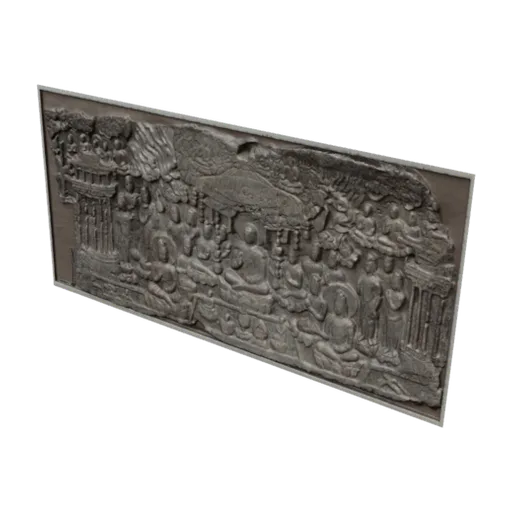
Western Paradise of the Buddha Amitabha
by National Museum of Asian Art
High relief carving of Western Paradise. Amitabha presides over a lotus pond that contains flowers opening to reveal newborn souls. Numerous deities and celestial attendants fill in the tableau.
Download
- glbGLB, web resolutionwestern-paradise-of-the-buddha-amitabha.glb · 10 MBDownload GLB, web resolution
- Triangles
- 149,967
- Vertices
- 93,733
- Materials
- 1
- Textures
- 3, up to 4096px
- Size (W × H × D)
- 3.46 × 1.72 × 0.13 m
- Rigged
- No
- Style
- 3D scan
CC0 (public domain)
Free for any use, commercial too. No credit needed.
- Use it in games, films, apps, ads, 3D prints and school work
- Sell what you make with it
- Change it, recolour it, cut it up
- Share the file itself
- Claim you made the original
Checked before it was listed
- Scanned for malware
- Opened and measured: the facts on this page come from the files
- No scripts or programs inside the download
- Licence confirmed at the source
File fingerprints (SHA-256)
western-paradise-of-the-buddha-amitabha.glb: ff4778a496481e7250484b110dcd349d69dd841d26116565b2c3e9f9caf865d0
Made by National Museum of Asian Art
High relief carving of Western Paradise. Amitabha presides over a lotus pond that contains flowers opening to reveal newborn souls. Numerous deities and celestial attendants fill in the tableau.
The Buddha of Infinite Light (Sanskrit, Amitabha), is lord of the Pure Land called the Western Paradise. Devotees believe that absolute faith in Amitabha entitles a person to be reborn in that paradise. In this mural, Amitabha presides over a pond and welcomes newly reborn souls who emerge from within lotus blossoms. This mural is among the earliest known depictions of the Western Paradise in Chinese art. It is from the Southern Xiangtangshan Buddhist cave-temple site, Cave 2. The Xiangtangshan caves were located close to the city of Ye, the capital of the Northern Qi dynasty. Their carving was an imperially sponsored project. A related object in the Freer collection is F1921.1.
Before 1920
Removed from Cave Temples of Xiangtangshan, Fengfeng, Handan Municipality, Hebei Province by unknown party [1]
By 1920 to 1921
Lai-Yuan & Company, New York, Pekin, Shanghai, and Paris acquired from an unknown source [2]
From 1921
Freer Gallery of Art purchased from Lai-Yuan & Co. in installments, the first of which was issued in May 1921 [3]
Notes:
[1] In the very early in the 20th century, the Cave Temples of Xiangtangshan suffered extensive damage and theft. The reliefs were removed from Cave 2 of the Southern group prior to 1920 when the Japanese team of Tokiwa and Sekino surveyed the site. See Shina Bukkyo Shiseki, Tokyo, 1927, vol. 3, pp. 53 ff., the two reliefs are not mentioned at all. J. Keith Wilson and Daisy Yiyou Wang outline when figures and fragments were removed from Xiangtangshan in “The Early-Twentieth-Century ‘Discovery’ of the Xiangtangshan Caves” in Echoes of the Past: The Buddhist Cave Temples of Xiangtangshan (Smart Museum of Art. Chicago IL with Arthur M. Sackler Gallery, Washington DC, 2010), 125-126.
[2] Lai-Yuan & Company, New York had this object and another large relief carving (F1921.1) in their possession in October 1920, see: Letter from Charles D. Walcott, Secretary of Smithsonian to Colonel Frank J. Hecker of Detroit, February 15, 1921, copy in object file. On November 22, 1920, Lai-Yuan & Company offered these pieces to the nascent Freer Galley of Art when they sent a letter quoting prices, see letters unsigned (likely from Katherine N. Rhoades) to Y.Z. Li, November 24 and December 8, 1920, copies in file. Lai-Yuan and company describes these objects as “Two Huge Archaic Stone Slabs of Norther Wei Dynasty,” see object descriptions, copy in object file.
[3] On March 21, 1921, Lai-Yuan & Company sent this object, F1921.1, and F1921.3 to the Freer Gallery of Art via railroad. The objects arrived on March 29, however, the two stone relief sculptures, F1921.1 & F1921.2, were damaged. Lai-Yuan & Company completed repairs on these objects in November 1922 (for entire exchange regarding damage and repair, see correspondence in object file).
The Freer Gallery of Art paid for the objects in instalments, the first of which was issued in May 1921 and the final on January 10, 1922, see letter from C. T. Loo to Miss. K. N. Roades, May 4, 1921 and unsigned letter (likely from Dr. Lodge) to “Gentlemen,” Lai-Yuan & Company, January 10, 1922, copies in object file.
Freer Gallery of Art Collection
Promise of Paradise (October 14, 2017 - ongoing)
Promise of Paradise: Early Chinese Buddhist Sculpture (December 1, 2012 to January 3, 2016)
Echoes of the Past: The Buddhist Cave Temples of Xiangtangshan (February 26, 2011 to January 6, 2013)
Buddhist Art (May 9, 1993 to August 9, 2011)
Chinese Art—Stone Sculpture (September 1, 1979 to March 14, 1982)
Chinese Art (January 1, 1963 to March 6, 1981)
Centennial Exhibition, Gallery 17 (November 17, 1955 to January 1, 1963)
Stone Sculpture, Gallery 17, 1923 (May 2, 1923 to November 17, 1955)
Lai-Yuan & Company (ca. 1915-April 1921)
From National Museum of Asian Art, released by the Smithsonian under CC0 through its Open Access programme. The Smithsonian does not endorse ModelsXi. Its own page has the object record and other copies, including full-resolution and print-ready files where they exist.
More museum scans
 Free
 Free
 Free
 Free
 Free
 Free
 Free
 Free
 Free
 Free
 Free
 Free
 Free
 Free
 Free
 Free