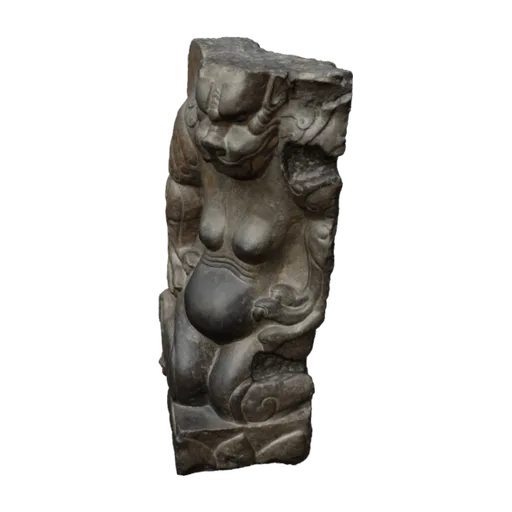
Kneeling winged monster
by National Museum of Asian Art
This mythical, composite animal and the similar one on the opposite side of the doorway are guardian-demons whose repellent ugliness was believed to avert evil. They were created as pillar bases, or a
Download
- glbGLB, web resolutionkneeling-winged-monster.glb · 10 MBDownload GLB, web resolution
- Triangles
- 149,999
- Vertices
- 82,126
- Materials
- 1
- Textures
- 3, up to 4096px
- Size (W × H × D)
- 0.49 × 0.87 × 0.41 m
- File units
- Millimetres
- Rigged
- No
- Style
- 3D scan
CC0 (public domain)
Free for any use, commercial too. No credit needed.
- Use it in games, films, apps, ads, 3D prints and school work
- Sell what you make with it
- Change it, recolour it, cut it up
- Share the file itself
- Claim you made the original
Checked before it was listed
- Scanned for malware
- Opened and measured: the facts on this page come from the files
- No scripts or programs inside the download
- Licence confirmed at the source
File fingerprints (SHA-256)
kneeling-winged-monster.glb: 220d38e1ea848f31dd6fd8ba11552b19da127c4f9c46494f145602c4a69a2864
Made by National Museum of Asian Art
This mythical, composite animal and the similar one on the opposite side of the doorway are guardian-demons whose repellent ugliness was believed to avert evil. They were created as pillar bases, or architectural supports, inside the Buddhist cave-temple of the northern Chinese site known as Xiangtangshan, which straddles the border of Hebei and Henan provinces. The presence of these guardians beneath a row of Buddha images in Cave 7 at Xiangtangshan signaled their role as protectors of Buddhist Law.
Cave 7 originally contained at least twenty-four similar sculptures, but they proved so appealing to Japanese and Western collectors that most of them were removed in the early twentieth century for sale. Many museums bought pairs of the guardian figures. Charles Lang Freer purchased only one (in 1916), but the Freer Gallery of Art purchased an additional two in the 1950s, and the gallery was later given two more in the 1970s. Each sculpture is slightly different.
The specific site of these pieces has been clearly known in the West since the 1950s, but when Mr. Freer made his purchase in 1916, he was unaware of where it came from in China and was told the work was slightly earlier than it actually is.
To 1916
Lai-Yuan and Company, New York, to 1916 [1]
From 1916 to 1919
Charles Lang Freer (1854-1919), purchased from Lai-Yuan and Company in 1916 [2]
From 1920
The Freer Gallery of Art, gift of Charles Lang Freer in 1920 [3]
Notes:
[1] See Original Miscellaneous List, S.I. 927, pg. 206, Freer Gallery of Art and Arthur M. Sackler Gallery Archives.
[2] See note 1.
[3] The original deed of Charles Lang Freer's gift was signed in 1906. The collection was received in 1920 upon the completion of the Freer Gallery.
Freer Gallery of Art Collection
Chinese Buddhist Sculpture in New Light (April 14, 2002 to September 8, 2003)
Buddhist Art (May 9, 1993 to August 9, 2011)
Untitled Exhibition, North Corridor (November 20, 1969 to December 11, 1984)
Chinese Art (January 1, 1963 to March 6, 1981)
Centennial Exhibition, Gallery 17 (November 17, 1955 to January 1, 1963)
Stone Sculpture, Gallery 17, 1923 (May 2, 1923 to November 17, 1955)
Untitled Exhibition, Asian Sculpture, North Corridor (May 2, 1923 to October 28, 1955)
Lai-Yuan & Company (ca. 1915-April 1921) (C.L. Freer source)
Charles Lang Freer (1854-1919)
From National Museum of Asian Art, released by the Smithsonian under CC0 through its Open Access programme. The Smithsonian does not endorse ModelsXi. Its own page has the object record and other copies, including full-resolution and print-ready files where they exist. The file is measured in millimetres, so engines that expect metres will show it 1,000 times too large; the size above is the real one.
More museum scans
 Free
 Free
 Free
 Free
 Free
 Free
 Free
 Free
 Free
 Free
 Free
 Free
 Free
 Free
 Free
 Free