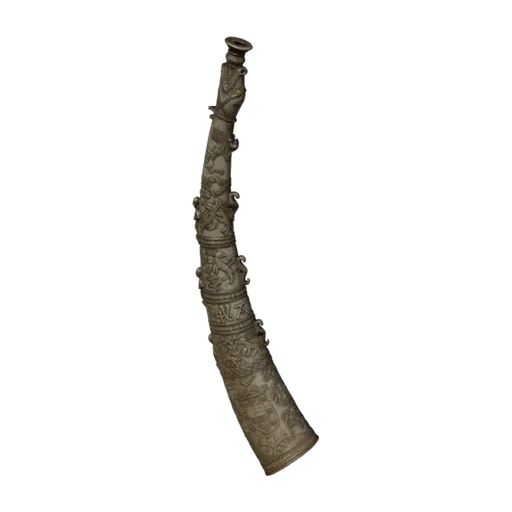
Hunting horn
by National Museum of African Art
While the source of the materials and the superb artistry of this hunting horn can be attributed to Sierra Leone, certain of its features suggest that it was made by a Bullom or Temne artist for a Eur
Download
- glbGLB, web resolutionhunting-horn.glb · 9.5 MBDownload GLB, web resolution
- Triangles
- 149,986
- Vertices
- 82,525
- Materials
- 1
- Textures
- 3, up to 4096px
- Size (W × H × D)
- 0.19 × 0.64 × 0.09 m
- Rigged
- No
- Style
- 3D scan
CC0 (public domain)
Free for any use, commercial too. No credit needed.
- Use it in games, films, apps, ads, 3D prints and school work
- Sell what you make with it
- Change it, recolour it, cut it up
- Share the file itself
- Claim you made the original
Checked before it was listed
- Scanned for malware
- Opened and measured: the facts on this page come from the files
- No scripts or programs inside the download
- Licence confirmed at the source
File fingerprints (SHA-256)
hunting-horn.glb: dddc5eec721af4848c38be85a38cf850906584d59718d78b29db426c4cb3c9af
Made by National Museum of African Art
While the source of the materials and the superb artistry of this hunting horn can be attributed to Sierra Leone, certain of its features suggest that it was made by a Bullom or Temne artist for a European client. The positioning of its mouthpiece, its suspension lugs, as well as the scenes of a European hunt carved in relief and most likely based upon European prints all indicate the horn was produced for export. This horn is one of only three surviving horns attributed to the same hand. The heraldic shields and inscriptions carved near its base by this unidentified master artist help narrow the dating of its creation to between 1494 and 1500 and identify it as a royal gift from Crown Prince Manuel I of Portugal to King Ferdinand V of Castile and Aragon.
West African ivories were coveted luxuries in Europe in the late 15th and 16th centuries and considered worthy as royal gifts. Increased international demand for ivory in subsequent centuries has endangered elephant populations however, giving rise to current international bans on its export and use.
Ivory end blown horn with segmented horizontal carvings in tiers from the top to the bottom. The figures are of animals and humans. There are also plant forms (trees) and letters (Greek). Each band is carved with high and low relief objects and separated by lattice, beading or braiding. There are five carved S-shaped ivory loops on the side. Three have metal chains attached.
Private collection, France
Paul and Ruth Tishman, New York, before 1981 to 1984
Walt Disney World Co.
Visionary: Viewpoints on Africa's Arts, National Museum of African Art, Smithsonian Institution, Washington, D.C., November 4, 2017-ongoing
African Mosaic: Selections from the Permanent Collection, National Museum of African Art, Smithsonian Institution, Washington, D.C., November 19, 2013–August 12, 2019 (installed May 14, 2014-June 8, 2017)
The Walt Disney-Tishman African Art Collection Highlights, National Museum of African Art, Smithsonian Institution, Washington, D.C., May 21, 2009-June 4, 2014 (deinstalled May 14, 2014)
African Vision: The Walt Disney-Tishman African Art Collection, National Museum of African Art, Smithsonian Institution, Washington, D.C., February 15, 2007-March 31, 2009
Encompassing the Globe: Portugal and the World in the 16th & 17th Centuries, National Museum of African Art and the Arthur M. Sackler Gallery, Smithsonian Institution, Washington, D.C., June 23-September 16, 2007; Palais des Beaux-Arts de Bruxelles
First Look: The Walt Disney-Tishman Collection of African Art, National Museum of African Art, Smithsonian Institution, Washington, D.C., May 17-December 3, 2006
Art of the Personal Object, National Museum of African Art, Smithsonian Institution, Washington, D.C., September 24, 1991-April 9, 2007
Africa and the Renaissance: Art in Ivory, Center for African Art, New York, November 1988 - April 1989, Museum of Fine Arts, Houston, 1989
For Spirits and Kings: African Art from the Paul and Ruth Tishman Collection, Metropolitan Museum of Art, New York, 1981
Bassani, Ezio and William Fagg. 1988. Africa and the Renaissance: Art in Ivory. New York: Center for African Art, pp. 99, 107, 109, 139, 140, 141; no. 76.
Hornbeck, Stephanie. 2016. "Ivory: I dentification and Regulation of a Precious Material." National Museum of African Art Conservation Lab publication. p.1.
Kreamer, Christine Mullen. 2006. "African Vision: The Walt Disney-Tishman African Art Collection." Tribal Arts 43, p. 86, nos. 11-12.
Kreamer, Christine Mullen, Bryna Freyer and Andrea Nicolls. 2007. African Vision: The Walt Disney-Tishman African Art Collection. Washington, D.C.: National Museum of African Art, Smithsonian Institution, pp. 54, 68-69, fig. 13, no. 15.
Levenson, Jay A. (ed). 2007. Encompassing the Globe: Portugal and the World in the 16th & 17th Centuries. Washington, D.C.: Arthur M. Sackler Gallery, Smithsonian Institution, p. 152, no. A-5.
Mellor, S. 2007. From Delicious to Not Quite Right: Subtleties in Discerning the Authenticity of African Art. Objects Specialty Group Postprints, Volume 14 CD. Washington, DC: American Institute for Conservation of Historic and Artistic Works. p.14.
National Museum of African Art. 2007. 2007-2008 School Calendar: Featuring the new Let's Read about Africa and the Sounds of African Music programs. Museum calendar. Washington, D.C.: National Museum of African Art, Smithsonian Institution, January 2008.
Patton, Sharon F. 2005. "Disney-Tishman: Gift to the Smithsonian Institution." Tribal Art X:2 (39), p. 63, no. 5.
Patton, Sharon F. and Bryna Freyer. 2008. Treasures 2008. Washington D.C.: National Museum of African Art, Smithsonian Institution, pp. 4-5.
Robbins, Warren M. and Nancy Ingram Nooter. 1989. African Art in American Collections. Washington, D.C.: Smithsonian Institution Press, p. 154, no. 282.
Ross, Doran (ed). 1992. Elephant: The Animal and Its Ivory in African Culture. Los Angeles: Fowler Museum of Cultural History, University of California, p. 293, no. D.
Skoda, Hannah, Patrick Lantschner and R. L. J. Shaw (eds). 2012. Contact and Exchange in Later Medieval Europe: Essays in Honour of Malcolm Vale. Rochester: Boydell & Brewer.
Visoná, Monica Blackmun, Robin Poyner, Herbert M. Cole and Michael D. Harris. 2001. A History of Art in Africa. New York: Harry N. Abrams, p. 172, no. 6-6.
Visoná, Monica Blackmun, Robin Poyner and Herbert M. Cole. 2008. A History of Art in Africa. Upper Saddle River, N.J.: Prentice Hall, p. 172, no. 6-6.
Vogel, Susan (ed). 1981. For Spirits and Kings: African Art from the Paul and Ruth Tishman Collection. New York: Metropolitan Museum of Art, pp. 64-67, no. 30.
As part of our commitment to accessibility and transparency, the Smithsonian National Museum of African Art is placing its collection records online. Please note that some records are incomplete (missing image or content descriptions) and others reflect out-of-date language or systems of thought regarding how to engage with and discuss cultural heritage and the specifics of individual artworks. If you see content requiring immediate action, we will do our best to address it in a timely manner. Please email nmafacuratorial@si.edu if you have any questions.
High resolution digital images are not available for some objects. For publication quality photography and permissions, please contact the Eliot Elisofon Photographic Archives at https://africa.si.edu/research/eliot-elisofon-photographic-archives/
From National Museum of African Art, released by the Smithsonian under CC0 through its Open Access programme. The Smithsonian does not endorse ModelsXi. Its own page has the object record and other copies, including full-resolution and print-ready files where they exist.
More museum scans
 Free
 Free
 Free
 Free
 Free
 Free
 Free
 Free
 Free
 Free
 Free
 Free
 Free
 Free
 Free
 Free