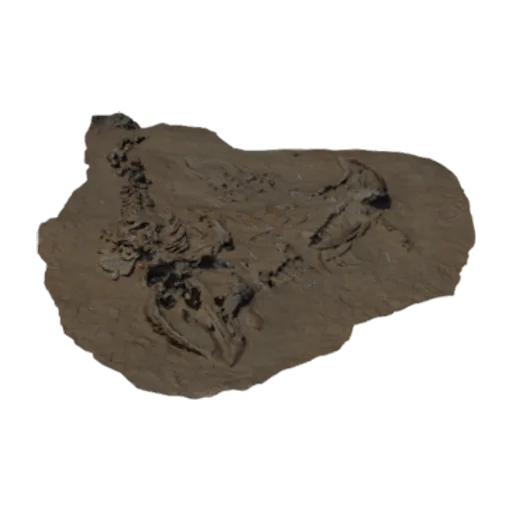
Fossil whale excavation site MPC 665-667
by NMNH - Paleobiology Dept.
Cerro Ballena is a unique fossil site near the town of Caldera, in the Atacama Region of northern Chile that preserved several dozen skeletons of fossil whales. After road expansion of the Pan-Americ
Download
- glbGLB, web resolutionfossil-whale-excavation-site-mpc-665-667.glb · 24 MBDownload GLB, web resolution
- Triangles
- 99,989
- Vertices
- 299,959
- Materials
- 1
- Textures
- 3, up to 4096px
- Size (W × H × D)
- 8.88 × 0.54 × 9.29 m
- File units
- Millimetres
- Rigged
- No
- Style
- 3D scan
CC0 (public domain)
Free for any use, commercial too. No credit needed.
- Use it in games, films, apps, ads, 3D prints and school work
- Sell what you make with it
- Change it, recolour it, cut it up
- Share the file itself
- Claim you made the original
Checked before it was listed
- Scanned for malware
- Opened and measured: the facts on this page come from the files
- No scripts or programs inside the download
- Licence confirmed at the source
File fingerprints (SHA-256)
fossil-whale-excavation-site-mpc-665-667.glb: 489c9614340f417e9e2b815d48c7e8668975f7045232598d75fa8d04ebe8c7b7
Made by NMNH - Paleobiology Dept.
Cerro Ballena is a unique fossil site near the town of Caldera, in the Atacama Region of northern Chile that preserved several dozen skeletons of fossil whales. After road expansion of the Pan-American Highway from 2010-2011, Chilean and US paleontologists documented over 40 skeletons of fossil whales and other marine animals at this site. Interestingly, these fossils derived four separate bone-bearing levels that were layered one on top of each other at the site; these fossil whales(MPC 665-667) were collected on bone-bearing level BL-1. Smithsonian’s Digitization Program Office created the 3D models of fossil whales from Cerro Ballena using a variety of techniques, including laser scanning and photogrammetry. Fossils from Cerro Ballena are between 7-9 million years old, from a geologic time known as the late Miocene. Excavations by Chilean and Smithsonian scientists revealed a diversity of individual fossil whale skeletons at this site included several different species of whales with adults and juveniles preserved as complete skeletons. The density of fossil whales at Cerro Ballena is the richest known so far in the world. Many of the fossil whale skeletons were intact, including the skull and jaws preserved in articulation with the vertebral column (or backbone), and sometimes along with the bones of the forelimbs (or flippers). Scientists used 3D models of these skeletons to score the degree of anatomical connections among the bones and measure specific aspects of how far the bones in the skeleton have shifted from their life articulation. Overall, the bones from the fossil whale skeletons at Cerro Ballena showed little sign of disturbance or scavenging by large animals, which suggests that a short time from death to burial. Geological work at Cerro Ballena pointed to the rock layers representing an ancient tidal flat. The fact that skeletons at the site were discovered only meters away from each other also suggests their bodies were concentrated at the site, likely by wave action; many of the skeletons were buried belly up, providing further evidence that the whales were already long dead by the time they arrived at the tidal flat. Together, the evidence point to ancient harmful algal blooms are the likeliest cause for the deaths of all of the animals at the site; also, it is a cause that can repeat through time, and explain the accumulation of whales and other animals at Cerro Ballena across each of the four bone-bearing layers. Although excavations of the highway expansion are now complete, fossils preserved in rock strata that extend west and east at the roadcut suggest that hundreds of more skeletons remain buried nearby. These scope and density of skeletons from the site make it unique, on par with the La Brea Tar Pits or Dinosaur National Monument in the United States. Read the scientific paper: https://royalsocietypublishing.org/doi/full/10.1098/rspb.2013.3316 For more images and data from the site, see: https://www.si.edu/newsdesk/photos/cerro-ballena-fossil-whales
From NMNH - Paleobiology Dept., released by the Smithsonian under CC0 through its Open Access programme. The Smithsonian does not endorse ModelsXi. Its own page has the object record and other copies, including full-resolution and print-ready files where they exist. The file is measured in millimetres, so engines that expect metres will show it 1,000 times too large; the size above is the real one.
More museum scans
 Free
 Free
 Free
 Free
 Free
 Free
 Free
 Free
 Free
 Free
 Free
 Free
 Free
 Free
 Free
 Free