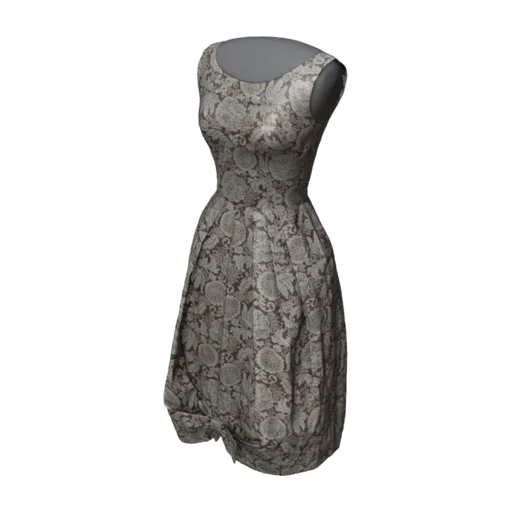
Feedsack Dress
by National Museum of American History
Life on America's farms in the 1920s and 1930s meant hard work and frugal habits. Farm families were used to "making do" with what they had, wasting nothing that could be recycled or reused. With feed
Download
- glbGLB, web resolutionfeedsack-dress.glb · 4.5 MBDownload GLB, web resolution
- Triangles
- 99,999
- Vertices
- 60,133
- Materials
- 1
- Textures
- 3, up to 2048px
- Size (W × H × D)
- 0.46 × 1.08 × 0.43 m
- Rigged
- No
- Style
- 3D scan
CC0 (public domain)
Free for any use, commercial too. No credit needed.
- Use it in games, films, apps, ads, 3D prints and school work
- Sell what you make with it
- Change it, recolour it, cut it up
- Share the file itself
- Claim you made the original
Checked before it was listed
- Scanned for malware
- Opened and measured: the facts on this page come from the files
- No scripts or programs inside the download
- Licence confirmed at the source
File fingerprints (SHA-256)
feedsack-dress.glb: 12c0e8d353660d8945127b9ea023501953524b10285e9ff5f2dbdc1da192ae9b
Made by National Museum of American History
Life on America's farms in the 1920s and 1930s meant hard work and frugal habits. Farm families were used to "making do" with what they had, wasting nothing that could be recycled or reused. With feed sacks and flour bags, farmwomen took thriftiness to new heights of creativity, transforming the humble bags into dresses, underwear, towels, curtains, quilts, and other household necessities.
By the 1940s the bag manufacturers were turning out bags in bright colors and printed designs. It was felt that these designs and colors would boost sales, because the woman of the house would always select the brand with the most attractive fabric. During World War II, there was a shortage of cotton fabric for the civilian population, and the recycling of bags became a necessity, encouraged by the government.
After the war, the bags were not only a sign of domestic thrift; they also gave rural women a sense of fashion. National sewing contests were organized as a way for women to show off their skills, and manufacturers to show off their designs. Women frequently sold their surplus bags to others as a way of picking up cash to aid in running the home.
This dress was made by Mrs. G. R. (Dorothy) Overall of Caldwell, Kansas, in 1959 for the Cotton Bag Sewing Contest sponsored by the National Cotton Council and the Textile Bag Manufactureres Association. The dress is made of cotton bag fabric, with an overall design of white flowers on a brown (originally black) ground. The dress is lined with black organdy, and machine quilted with a synthetic silver sewing thread. Mrs. Overall was awarded 2nd place in the Mid-South section of the contest.
Currently not on view
From National Museum of American History, released by the Smithsonian under CC0 through its Open Access programme. The Smithsonian does not endorse ModelsXi. Its own page has the object record and other copies, including full-resolution and print-ready files where they exist.
More museum scans
 Free
 Free
 Free
 Free
 Free
 Free
 Free
 Free
 Free
 Free
 Free
 Free
 Free
 Free
 Free
 Free