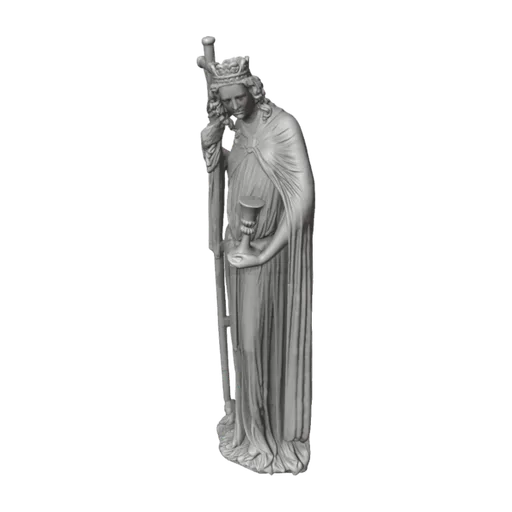
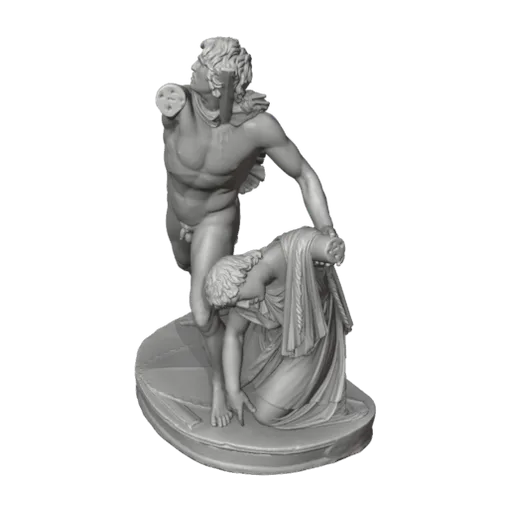
Ecclesia, the Church triumphant, with a cross staff
by Royal Cast Collection, SMK
Ecclesia, the Church triumphant, with a cross staff: a plaster cast from SMK's Royal Cast Collection, scanned in 3D.
Download
- glbGLB, plaster finishecclesia-the-church-triumphant-with-a-cross-staff.glb · 6.9 MBDownload GLB, plaster finish
- stlSTL, SMK's scan (3D printing)ecclesia-the-church-triumphant-with-a-cross-staff.stl · 19 MBDownload STL, SMK's scan (3D printing)
- Triangles
- 300,000
- Vertices
- 149,971
- Materials
- 1
- Textures
- None
- Size (W × H × D)
- 0.69 × 2.02 × 0.66 m
- Rigged
- No
- Style
- 3D scan
Public domain
No known copyright: free for any use, commercial too. No credit needed.
- Use it in games, films, apps, ads, 3D prints and school work
- Sell what you make with it
- Change it, recolour it, cut it up
- Share the file itself
- Claim you made the original
- Suggest the museum endorses you
Checked before it was listed
- Scanned for malware
- Opened and measured: the facts on this page come from the files
- No scripts or programs inside the download
- Licence confirmed at the source
File fingerprints (SHA-256)
ecclesia-the-church-triumphant-with-a-cross-staff.glb: c4050e2a93f630fdecb5034fa44200b3d02c6b4b67e86a796a9061e0e8f05d62
ecclesia-the-church-triumphant-with-a-cross-staff.stl: c145253983e5f866a106e64c5a4e90803869a83f9b3f6010eb86597fbb0994c4
Made by Royal Cast Collection, SMK
Ecclesia Sancta, also known as ‘Christianity Victorious’ and Synagoga, known as ‘Judaism Vanquished’, are casts of statues from the cathedral of Notre Dame de Strasbourg in Alsace in what is now northern France. The original works are from c. 1230.The casts were acquired for the Royal Cast Collection in 1898. Here they were to act as typical examples of the Gothic style, pointing to how the human figure was headed for freedom and detachment from fixed ideals—a process which indeed happened later in the Renaissance. Here, however, the bodies are still part of a wider architectural setting, unnaturally elongated, trapped in their clothing and forced to represent conventions prevalent in the age when they were made. The theme of the works, Christianity humiliating Judaism, was widespread in the Middle Ages, and has thus remained visible to this day. The female figure symbolising Christianity wears a crown. One hand holds the cup containing the blood of Christ, the other the banner of a crusader. The cup or chalice symbolising Christ’s atoning death on the cross, marks the dividing line between the Old and New Testaments. By contrast, the figure representing Judaism has been blindfolded, her head bowed down so low that her crown has fallen off. She holds a broken lance and the Tablets of the Law with the ten commandments, seemingly about to drop them. The original work had an inscription above the heads of the figures in which they address each other: ‘Christianity’ says: ‘With the blood of Christ I overcome you,’ to which ‘Judaism’ replies: ‘The same blood blinds me.’ The works constitute a call for holy war, Crusade, against Judaism, which has here been appropriated for the benefit of Christianity and forced to play the role of someone already vanquished, blind and weak.
A plaster cast in the Royal Cast Collection of SMK, the National Gallery of Denmark, scanned in 3D. SMK publishes the scan with the Public Domain Mark: no known copyright. SMK does not endorse ModelsXi.
Danish title: Ecclesia sancta, Den sejrende kristendom med korsstav.
More museum scans
 Free
 Free
 Free
 Free
 Free
 Free
 Free
 Free
 Free
 Free
 Free
 Free
 Free
 Free
 Free
 Free