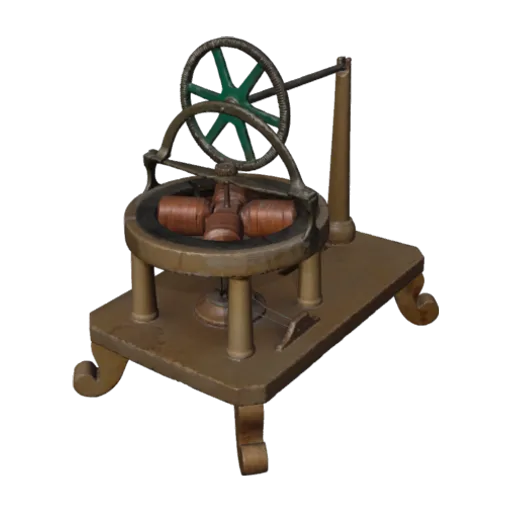
Davenport electric motor, US patent #132
by National Museum of American History
Model to accompany US patent number 132, "Electric Motor, issued to Thomas Davenport, 25 February 1837. This is the first US patent issued for an electric motor. No extant markings. The patent claims:
Download
- glbGLB, web resolutiondavenport-electric-motor-us-patent-132.glb · 4.1 MBDownload GLB, web resolution
- Triangles
- 100,002
- Vertices
- 62,306
- Materials
- 1
- Textures
- 3, up to 2048px
- Size (W × H × D)
- 0.26 × 0.37 × 0.38 m
- Rigged
- No
- Style
- 3D scan
CC0 (public domain)
Free for any use, commercial too. No credit needed.
- Use it in games, films, apps, ads, 3D prints and school work
- Sell what you make with it
- Change it, recolour it, cut it up
- Share the file itself
- Claim you made the original
Checked before it was listed
- Scanned for malware
- Opened and measured: the facts on this page come from the files
- No scripts or programs inside the download
- Licence confirmed at the source
File fingerprints (SHA-256)
davenport-electric-motor-us-patent-132.glb: f87170331d924e5b73a64383bb9b0d86cbdee595c25e632949af11008e7a7f15
Made by National Museum of American History
Model to accompany US patent number 132, "Electric Motor, issued to Thomas Davenport, 25 February 1837. This is the first US patent issued for an electric motor. No extant markings. The patent claims: "Applying magnetic and electromagnetic power as a moving principle for machinery in the manner above described, or in any other substantially the same in principle". Wooden base, 9 by 14 in., supported on four curved legs, carrying a circular frame, in which there are four rough electro-magnets, painted red, made to revolve within a ring of steel magnets. The steel magnets in the ring are crescent-shaped can be lifted out of the frame. Reference: W. James King, Development of Electrical Technology in the 19th Century (Smithsonian Institution, 1962), 264.
This model was made by Vermont blacksmith Thomas Davenport (1802-1851) as a replacement for his original patent model. The original was destroyed in the 1836 fire at the US Patent Office. Davenport may have incorporated improvements in this model that are not reflected in the patent drawings.
From National Museum of American History, released by the Smithsonian under CC0 through its Open Access programme. The Smithsonian does not endorse ModelsXi. Its own page has the object record and other copies, including full-resolution and print-ready files where they exist.
More museum scans
 Free
 Free
 Free
 Free
 Free
 Free
 Free
 Free
 Free
 Free
 Free
 Free
 Free
 Free
 Free
 Free