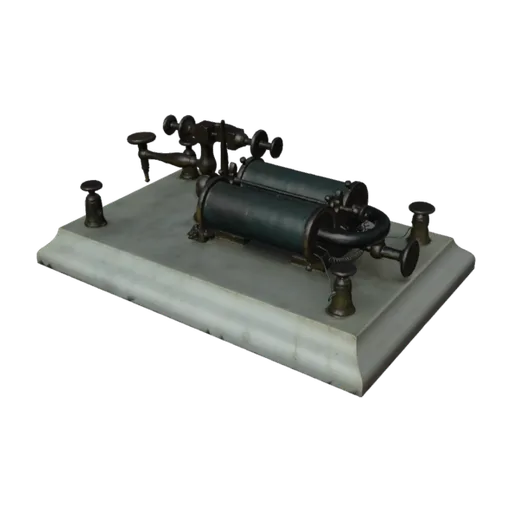
Chester telegraph relay
by National Museum of American History
Telegraph relays amplified electrical signals in a telegraph line. Telegraph messages traveled as a series of electrical pulses through a wire from a transmitter to a receiver. Short pulses made a dot
Download
- glbGLB, web resolutionchester-telegraph-relay.glb · 1.7 MBDownload GLB, web resolution
- Triangles
- 100,000
- Vertices
- 64,575
- Materials
- 1
- Textures
- 3, up to 2048px
- Size (W × H × D)
- 0.21 × 0.09 × 0.14 m
- Rigged
- No
- Style
- 3D scan
CC0 (public domain)
Free for any use, commercial too. No credit needed.
- Use it in games, films, apps, ads, 3D prints and school work
- Sell what you make with it
- Change it, recolour it, cut it up
- Share the file itself
- Claim you made the original
Checked before it was listed
- Scanned for malware
- Opened and measured: the facts on this page come from the files
- No scripts or programs inside the download
- Licence confirmed at the source
File fingerprints (SHA-256)
chester-telegraph-relay.glb: 44730b83c713bf2afd5a1aeb6ed784b5c84b1897df41fa46096ca433fe4a6bd1
Made by National Museum of American History
Telegraph relays amplified electrical signals in a telegraph line. Telegraph messages traveled as a series of electrical pulses through a wire from a transmitter to a receiver. Short pulses made a dot, slightly longer pulses a dash. The pulses faded in strength as they traveled through the wire, to the point where the incoming signal was too weak to directly operate a receiving sounder or register. A relay detected a weak signal and used a battery to strengthen the signal so that the receiver would operate.
This relay includes a marble base and was made by Charles T. Chester of New York City. The electromagnet coils are fixed but the steel core can be moved to adjust the strength of the magnetic field.
From National Museum of American History, released by the Smithsonian under CC0 through its Open Access programme. The Smithsonian does not endorse ModelsXi. Its own page has the object record and other copies, including full-resolution and print-ready files where they exist.
More museum scans
 Free
 Free
 Free
 Free
 Free
 Free
 Free
 Free
 Free
 Free
 Free
 Free
 Free
 Free
 Free
 Free