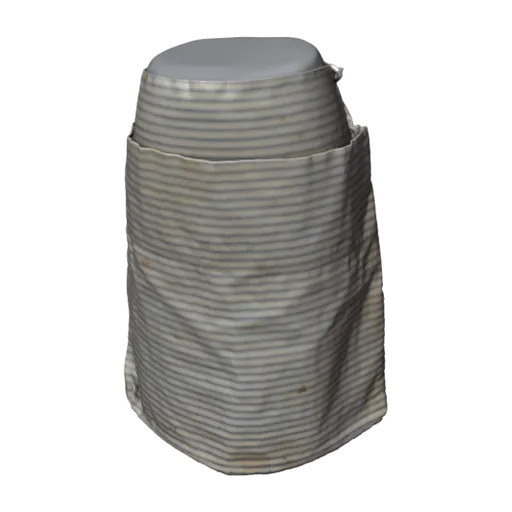
apron
by National Museum of American History
Apron; weaver's, blue and white striped cotton ticking. Half apron. Apron has one large pocket, 13.875" (35cm) deep; inside is a 1.25" (3.2cm) wide strip sewn with channels to hold reed hooks. The rev
Download
- glbGLB, web resolutionapron.glb · 6.3 MBDownload GLB, web resolution
- Triangles
- 99,999
- Vertices
- 58,342
- Materials
- 1
- Textures
- 3, up to 4096px
- Size (W × H × D)
- 0.30 × 0.45 × 0.24 m
- Rigged
- No
- Style
- 3D scan
CC0 (public domain)
Free for any use, commercial too. No credit needed.
- Use it in games, films, apps, ads, 3D prints and school work
- Sell what you make with it
- Change it, recolour it, cut it up
- Share the file itself
- Claim you made the original
Checked before it was listed
- Scanned for malware
- Opened and measured: the facts on this page come from the files
- No scripts or programs inside the download
- Licence confirmed at the source
File fingerprints (SHA-256)
apron.glb: 49afd8d3056eb7902350d1d16a565924334929fe0326577f24d55c4e2f776acb
Made by National Museum of American History
Apron; weaver's, blue and white striped cotton ticking. Half apron. Apron has one large pocket, 13.875" (35cm) deep; inside is a 1.25" (3.2cm) wide strip sewn with channels to hold reed hooks. The reverse has two pockets 6" (15cm) deep along the bottom edge of the apron. A strip, 16.75" (45cm) and 19" (48.2cm) is sewn at its center to each top corner of the apron; they appear to have been used to tie on the apron.
Girls built America. Girls’ work gave other women leisure time, they made industries more profitable, their cheap labor sparked a consumer revolution, and their activism reshaped labor laws. Through their labor and activism, they made workplaces safer for everyone.
Not all girls had a childhood because they had to work.
Young girls often worked as spinners or bobbin girls. Spinners ran machines that twisted fiber into yarn. Bobbin girls replaced full bobbins of yarn with empty ones. Often, girls wore aprons such as this one to protect their clothes.
Currently not on view
From National Museum of American History, released by the Smithsonian under CC0 through its Open Access programme. The Smithsonian does not endorse ModelsXi. Its own page has the object record and other copies, including full-resolution and print-ready files where they exist.
More museum scans
 Free
 Free
 Free
 Free
 Free
 Free
 Free
 Free
 Free
 Free
 Free
 Free
 Free
 Free
 Free
 Free