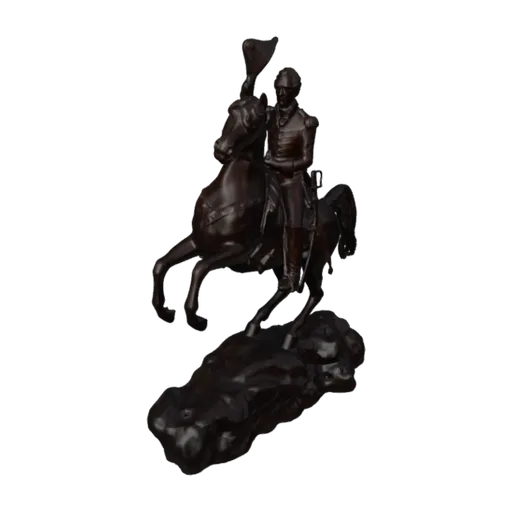
Andrew Jackson
by National Portrait Gallery
Born in the Waxhaw Settlement, South Carolina
Download
- glbGLB, web resolutionandrew-jackson.glb · 8.8 MBDownload GLB, web resolution
- Triangles
- 150,000
- Vertices
- 88,853
- Materials
- 1
- Textures
- 3, up to 4096px
- Size (W × H × D)
- 0.22 × 0.61 × 0.52 m
- File units
- Millimetres
- Rigged
- No
- Style
- 3D scan
CC0 (public domain)
Free for any use, commercial too. No credit needed.
- Use it in games, films, apps, ads, 3D prints and school work
- Sell what you make with it
- Change it, recolour it, cut it up
- Share the file itself
- Claim you made the original
Checked before it was listed
- Scanned for malware
- Opened and measured: the facts on this page come from the files
- No scripts or programs inside the download
- Licence confirmed at the source
File fingerprints (SHA-256)
andrew-jackson.glb: 3402ae657efa5ddfb06c7dd650d876e4f3e7ad80a5f6ceba70b4da3baf434fce
Made by National Portrait Gallery
Born in the Waxhaw Settlement, South Carolina
During the War of 1812 (1812–15), Andrew Jackson defeated the Muscogee (Creek) in the Southwest and became a national hero after the Battle of New Orleans (1815). This reputation helped him win the 1828 presidential election. Historians debate who “won” the war— the United States or Britain; the latter had depended on Native American alliances, such as those with Tecumseh and his confederacy of Native nations. But they agree that Native Americans, who were dispossessed of their lands, lost the most. Half of the Muscogee territory (most of today’s Alabama) was surrendered to the United States.
Nacido en Waxhaw Settlement, Carolina del Sur
Durante la Guerra de 1812 (1812–15), Andrew Jackson derrotó a los muscogees (creeks) en el suroeste y se convirtió en héroe nacional tras la batalla de Nueva Orleans (1815). Esta fama lo ayudó a ganar la presidencia en 1828. Los historiadores debaten quién “ganó” la guerra, si Estados Unidos o Gran Bretaña, pues esta última se valió de alianzas con pueblos nativos, tales como la confederación de naciones indígenas bajo Tecumseh. Pero todos concuerdan en que los indígenas, desposeídos de sus tierras, fueron quienes más perdieron. La mitad del territorio muscogee (casi toda la actual Alabama) fue entregada a EE.UU.
John L. and Ann B. Sanders; gift to NPG 1985
From National Portrait Gallery, released by the Smithsonian under CC0 through its Open Access programme. The Smithsonian does not endorse ModelsXi. Its own page has the object record and other copies, including full-resolution and print-ready files where they exist. The file is measured in millimetres, so engines that expect metres will show it 1,000 times too large; the size above is the real one.
More museum scans
 Free
 Free
 Free
 Free
 Free
 Free
 Free
 Free
 Free
 Free
 Free
 Free
 Free
 Free
 Free
 Free