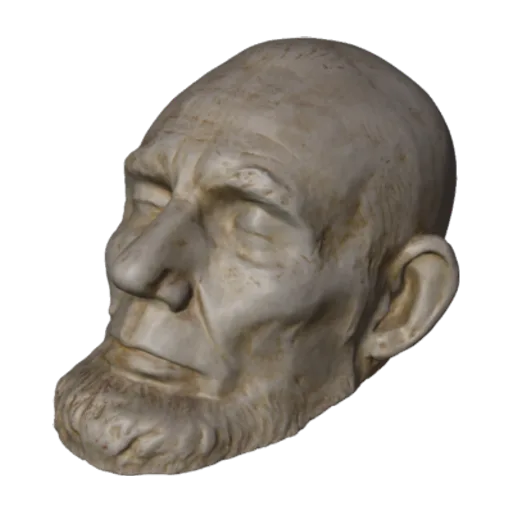
Abraham Lincoln
by National Portrait Gallery
Born Hardin County, Kentucky
Download
- glbGLB, web resolutionabraham-lincoln.glb · 8.2 MBDownload GLB, web resolution
- Triangles
- 150,000
- Vertices
- 86,245
- Materials
- 1
- Textures
- 3, up to 4096px
- Size (W × H × D)
- 0.21 × 0.18 × 0.29 m
- File units
- Millimetres
- Rigged
- No
- Style
- 3D scan
CC0 (public domain)
Free for any use, commercial too. No credit needed.
- Use it in games, films, apps, ads, 3D prints and school work
- Sell what you make with it
- Change it, recolour it, cut it up
- Share the file itself
- Claim you made the original
Checked before it was listed
- Scanned for malware
- Opened and measured: the facts on this page come from the files
- No scripts or programs inside the download
- Licence confirmed at the source
File fingerprints (SHA-256)
abraham-lincoln.glb: 4a40428307bf6908fc5ab603c1884a811355795d2c21c0d92d5a149e9bd265b9
Made by National Portrait Gallery
Born Hardin County, Kentucky
Looking at this cast of Abraham Lincoln’s face, which appears gaunt and careworn, one may think that it is a death mask, but in fact, it was taken from life on February 11, 1865, by sculptor Clark Mills. Life masks were popular in the nineteenth century because they created a duplicate of the subject’s features. A friend of Lincoln’s commented on the mask’s ability to portray “one on whom sorrow and care had done their worst.”
Nacido en Hardin County, Kentucky
Al observar esta escultura del rostro de Abraham Lincoln, demacrado y agotado, podría pensarse que se trata de una máscara funeraria; sin embargo, fue tomada en vida del presidente, el 11 de febrero de 1865, por el escultor Clark Mills. Las máscaras tomadas en vida fueron populares en el siglo XIX porque replicaban las facciones del modelo. Un amigo de Lincoln comentó que la mascara lograba mostrar a alguien “en quien se habían ensañado el dolor y la preocupación”.
National Museum of History and Technology (now National Museum of American History); transferred to NPG 1971
From National Portrait Gallery, released by the Smithsonian under CC0 through its Open Access programme. The Smithsonian does not endorse ModelsXi. Its own page has the object record and other copies, including full-resolution and print-ready files where they exist. The file is measured in millimetres, so engines that expect metres will show it 1,000 times too large; the size above is the real one.
More museum scans
 Free
 Free
 Free
 Free
 Free
 Free
 Free
 Free
 Free
 Free
 Free
 Free
 Free
 Free
 Free
 Free